
To understand the purpose of harmonic filtering, it helps to understand what harmonics are.
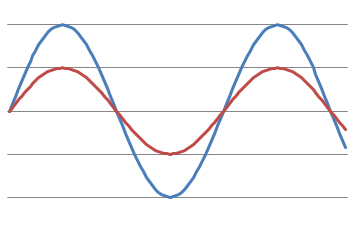
The voltage of a standard 50Hz AC (Alternating Current) power supply swings between positive and negative 50 times a second, following a neat sine-wave. Normal (linear) AC electrical loads such as heaters or incandescent lights draw a current that follows this same sine-wave.
The graph below shows typical voltage and current curves – voltage in blue and current in red.
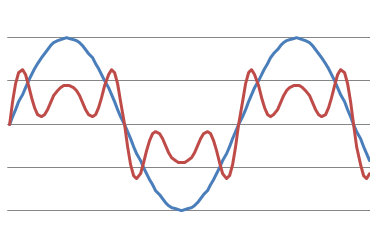
However, with non-linear loads such as VSDs (variable speed drives), the current does not nicely follow the voltage. The graph below shows an example of a non-linear current waveform. Through a set of calculations this non-sinusoidal wave can be broken down into many sine-wave components with frequencies of multiples of 50Hz. These components are called ‘harmonics.’ The amount of harmonics present is defined as a percentage of the 50Hz current.
What happens without harmonic filtering?
Harmonics caused by equipment such as VSDs can cause disturbances in the electrical grid that will not only affect equipment in the same installation, but also other consumers fed from the same transformer. Adverse effects of harmonics include additional heating and efficiency losses in transformers, motors and cables; random circuit breaker tripping; and interference with and damage to capacitor banks.
As a result, power authorities usually require harmonics to be kept to a minimum – typically <5%. To achieve this where non-linear loads are involved, harmonic filtering is often required.
Types of harmonic filtering
There are two main types of harmonic filters used for VSDs – passive and active.
Passive filters typically filter a single drive; meaning a separate filter is required for each VSD in a multiple VSD system. Passive filters are usually most effective when running at close to their rated capacity, so need to be sized carefully to suit the load.
Active filters monitor the current for a complete installation and inject currents to mitigate harmonics as required – so that a single active filter can be used for filtering of many VSDs of varying sizes. Many active filters can also compensate for other power quality issues such as low power factor. The trade-off is the cost – active filters are quite a bit more expensive than passive filters.